

Family Guy is an Animated family sitcom that began airing in 1999 and is currently in its 17th season. This show appeal to children and adults; hence, they have a broader audience to reach when compared to regular cartoons or movies. Here I will examine the show ‘Family guy’. The way the audience of the show may have changed, how the show is accepted internationally and assesse its problems with media regulations. Lastly, I will consider how Family guy compares to similar shows and how it can be improved.
However, Fox broadcasting company is a part of the media conglomerate “21st Century Fox”. Family Guy is centered on the Griffin family and their friends; all of whom reside in Quahog, Rhode Island (Ricke 2012, p.120).
My introduction to Family Guy
Family Guy occurred while watching Fox’s Sunday Night Lineup.
After watching my first episode of Family Guy, I was intrigued by the use of off-color humor and enjoyed watching the relationship that Stewie and Brian shared. I continued to watch the show casually. Hence, my opinion of the show has developed over time.
I believe that Family guy is a Satirical sitcom which relies heavily on dark comedy. Regularly, the show crosses boundaries, portrays racial stereotypes and makes fun of popular celebrities.
Some attempts at religious satire fall flat and come across as simply offensive. This can be seen in an episode where a cutaway shows that Jesus Christ died from Anal trauma and other insinuations that the Son of God walks the earth, sleeping with married women.
Importantly, the satirical nature of this show can be misunderstood by new viewers who had no prior warning about the content of Family guy (Podias 2011, p.320). A character like Herbert (the old paedophile who lives down the street), is offensive but reflects the type of people that live in a community.
Even some of the events portrayed are Satirical; a recent example is the response of the public to a joke that Brian made which was perceived as racist and made him a Pariah (Season 6, Episode 6). This was a reflection of the ‘woke era’ where we need to be careful about social media posts.
The evolution of Family Guy: Its main characters and content
Over the last 17 seasons, the show ‘family guy’ has changed. While the changes happened so gradually that they were barely noticeable, the evolution of the characters and content of the show is undeniable.
First of all, the way the main characters of the show have changed will be examined.
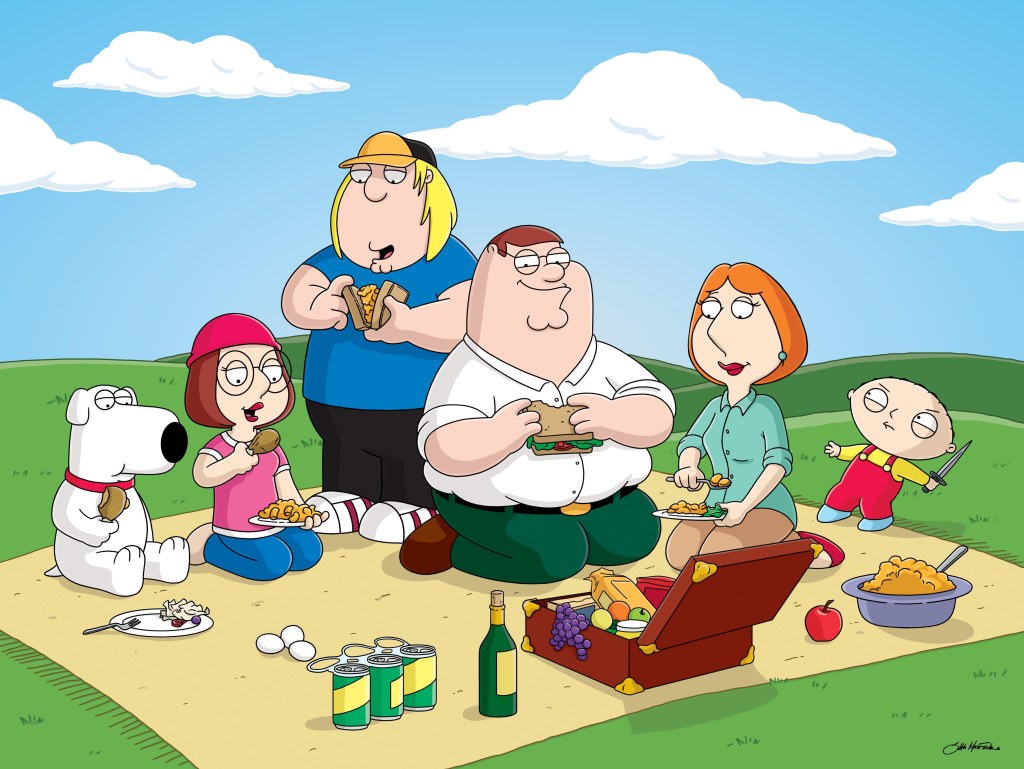
At the start of the show, the main characters included Peter (Father), Lois (Mother), Meg (Daughter), Chris (Son), Stewie (Baby) and Brian (Family pet) (Mills 2018, p.3).
Peter Griffin: Known for his idiotic actions and reckless statements, Peter Griffin is an Irish Catholic man. In the early seasons of the show, he was portrayed as a family man who worked at a toy factory, got drunk on the weekends and made stupid decisions which led to a series of cringe-comedy events.
Peter Griffin evolved into a man who worked in a brewery and consistently made terrible decisions. Alongside his decreased reasoning abilities, Peter’s character also shows a lack of tolerance towards gay, disabled people and misogyny which he displayed numerous times while talking to women.
Lois Griffin: Lois was a loving wife and mother. And, occasionally, she cleaned up Peter’s mistakes. Later, Lois is changed into a subpar mother who has used drugs, made a porn movie, tried to sleep with Meg’s boyfriend and even cheated on Peter with Bill Clinton.
Meg Griffin: The oldest child in the Griffin family. Initially M2eg was an average teenager trying to fit in at school. Now, she is the family punching bag and black sheep (Ryan 2015, p.76). Meg is now a character who everyone hates for no real reason.
Chris Griffin: The middle child, Chris is the younger version of Peter. While earlier episodes may have made Chris seem somewhat aware and goofy, this character evolved into an idiot who remains clueless in the most obvious of situations (Zenor & Oswego 2014, p.24). He is also now portrayed as a hypersexual teenager.
Stewie Griffin: At the start of the family series, Stewie was the diabolical genius baby who hated his mother and craved world domination. Stewie’s character evolved into a genius baby with a confused sexual orientation. His hate for Lois (mother) is not as prominent in the later seasons of the show.
Brian Griffin: The dog has always had a close relationship with Stewie (the baby), and that has not changed. However, Brian used to be the smart one in the family. He evolved into a contrarian and quack writer. Now, Brian can also be identified as an entitled liberal and self-righteous loser who never finishes what he starts (Schwerdtfeger 2018).
As the characters of the show changed, so did the content of the show:
Family guy can be classified as a satirical animation that employed black comedy to point out societal, political and religious issues. From inception, that has been the content of the show. However, as more episodes were made, it was evident that the writers were pushing the boundaries.
From making jokes about an Iraq Lobster who cries for death to America and butter sauce, they even created a Terri Shaivo Musical which was frowned on for being insensitive. The first and second seasons of the show are quite tame when compared to the later seasons and episodes.
Alongside the increased use of satire, dark humor and overall vulgarity, there has been an increased use of cutaways. Cutaway gags are scenes used to explain a statement made by a character (Mills 2018:3). Fans and casual audience of family guy have complained that there are too many cutaways in the show now. While cutaways should add comedic value to a show, if used too much, they can be distracting.
Lastly, there was a lesson to be learned by the family at the end of each episode. Now the show centers on the idiotic behavior of members of the Griffin family, disjointed cutaways and cringe-worthy jokes. At the end of newer episodes, there is less focus on explaining the lessons that were learned during the episode.
Analysis of the Audience
Some TV shows have a specific target audience; Family guy is watched by an interesting variation of people. It can be argued that Family guy is created for people born in the 1980s and after. This is because the jokes and cutaways refer to events, politics or celebrities that people born during the above stated period know.
Over the last 17 seasons, the show ‘family guy’ has changed. Here, I will explain why even though the show has changed, the audience has remained the same.
First of all, ‘Family guy’ can be classified as a satirical animation that employs black comedy to point out societal, political and religious issues. From inception, that has been the content of the show. However, as more episodes were made, it was evident that the writers were pushing the boundaries. The initial content attracted an audience that recognize, understand and enjoy satire. Despite the increasingly bold use of black comedy, family guy is still a satirical themed animation. The satirical contents which viewers enjoyed are unchanged, and this attracts the same audience (Lovers of satire).
The recent seasons have been targeted at teenagers and young adults because there have been numerous pop culture references included in the newer episodes. Some references have been made to Taylor Swift, Lindsay Lohan, and even the Star Wars franchise (Crawford 2009, p.63). This argument is supported by Martin (2005, p.39) who states that Family guy is saturated with references to TV shows, music, people and movies that the audience can recognize and connect to. The audience, in this case, being of a younger demographic.
Recently, Family guy used a cutaway based on the Polaner All Fruit Commercial which aired in 1989. The reason why the cutaway was funny had to be explained to the younger viewers. This was a recognition of the fact that family guy viewers range from 14-40 years old. This view is shared by Podias (20011, p.318) who argues that the audience of family guy is young adults who have now made this show a part of their media culture.
Therefore, because the show was rated PG14 from the start, increased integration of pop references that teens can relate to does not show an audience change. Rather, it proves that the makers of Family Guy recognize their audience and create relatable content for them.
Zenor (2014, p.28) has a slightly differing opinion as he states that the target audience of Family Guy is adults which are preferred in product placement and advertising. The matured content featured on the sitcom supports this assertion. Young adult and adults still make up the previous and current audience of the show.
In analyzing the current audience of family guy, it is also essential to assess the type of episodes that the show has been releasing for consumption.
Based on this, Franklin (2006) states that the jokes on Family Guy usually emphasize the role of masculinity and the traditional man. For this reason, the audience that family guy attracts ranges from the teenage boy to the young male adult. Stating a similar stance, Crawford (2009, p.8) argues that the main audience of Family Guy is male. This is possible because the sort of entertainment that Family guy provides may be more accepted by men than women (Martin 2005, p.68). Undeniably the sort of humor provided on Family guy propagates traditional male roles and displays the misogynistic tendencies of the male characters on the show. One example of this can be seen in where Peter called numerous homes campaigning for the Tea Party. In the episode, he demanded to speak to the man of the house and could not believe when one woman said there was no man in the home. He then proceeded to ask how she paid her phone bill. These sorts of jokes are why Marx (2013, p.179) argues that the show is targeted to males more so than females. Abinitio, there have been similar jokes on the show. Therefore, the male audience has always been more than the female audience.
To check how true the above arguments are, I examined the demographics of the IMDB Family Guy Ratings. There are 279,863 reviews written on the show. 198,297 of these reviews were written by individuals between the ages of 18-44. This supports the argument that the audience of the show is teenagers and adults. While people under 18 wrote 383 reviews.
184,713 of these reviews were written by males and 39,681 by females. These statistics emphasize the point that there is a larger male than the female audience of Family Guy. The IMDB rating demographic is a result of recorded reviews of Family Guy since the start of the show in 1999 (IMDB).
Significantly, the one way in which we can say the audience of Family Guy has been altered is that off-color jokes have narrowed down the previous audience. Jokes about Terri Shaivo, rape, abortion, being gay and even a recent portrayal of Donald Trump may have turned some people off the show. In spite of way Family Guy has developed over 17 seasons, the viewers of the show which includes lovers of satire, teens and young adults and a larger percentage of men than women have not changed.
Some of the plot and content on Family Guy has remained relatable to its audience. The Griffin family is a representation of the average Family with problems. Peter and Lois are a slight exaggeration of the challenges the average couple may face. They fight and argue but still love each other. Teens and Young adults may relate to the situations Meg and Chris find themselves in. Stewie and Brian have a dynamic relationship which many enjoy watching and it reminds them of the relationship between children and the family pet. Other characters like Quagmire, Joe, Cleveland, and even places like the drunken clam where Peter and his buddies go to hang out are things that still make the show relatable to its previous and current audience.
Family Guy vs other animated sitcoms
Two other animated sitcoms that are similar and in competition with Family Guy are; The Simpsons and American Dad. All three shows listed above have one thing in common; they are satires based on a family. Furthermore, at an initial glance, the Simpsons and Family Guy have similar themes (Crawford 2009, p.66).
Are the other shows better than family guy? There is no straight answer to this question.
The Simpsons have been aired for 30 years, and while its viewership has declined over the years, for a show of its age, this is expected. Also, The Simpsons have access to a broader target audience because it is not as provocative as Family Guy.
American dad is the youngest of these TV Sitcoms, and it is now in its 15th season. This animated show has used its fair share of dark humor. Despite a move from Fox to TBS, Loyal fans continue to watch the show. The characters on American dad changed as the show progressed, but the character development was applauded by viewers who felt the changes improved the dynamics of the sitcom.
Each of these shows has had a considerable period of longevity. However, each of these shows has differing themes which attract different audiences. As long as each show continues to gain viewership, I cannot state that one is widely better than the other.
Family Guy has been cancelled twice (in 2000 and 2002), the show returned and had higher viewership than some newer animated sitcoms (Ricke 2012, p.120).
Family Guy and Media Regulation
The need for media regulation is quite controversial. However, when it comes to the show ‘Family Guy’, it is unarguable that a lot of its content makes one wonder if this is one show that requires strict regulation.
The maker of family guy has stated numerous times that regulating the show could be akin to stifling creativity. The episode called PTV (Season 4, Episode 14), makes a mockery of the FCC censoring TV shows.
The FCC has received over 170,000 complaints about the content on Family Guy which makes the show unsuitable for family viewing. While the series does not clearly show vulgar or offensive acts, they simulate it or imply the action (Ricke 2012, p.132). In one episode, it was insinuated that Peter was raped by a bull. In other episodes, it is suggested that Quagmire rapes women who come to his home. Scenes that portray incest, bestiality, rape, violence, racism, prejudice against gay individuals, etc. are reasons why some individuals prefer that the show is censored and subject to media regulation.
Notably, the writers of the show disguise some sexual acts using innuendos which children cannot understand. Despite the PG14 rating and family value themed song, it is quite apparent that family guy is not suitable for family viewing (Martin 2005, p.16).
International reception of Family Guy
Family Guy is known internationally but, in some countries, words or phrases are censored to meet regulatory requirements. It is quite challenging to measure worldwide reception of the show, but it is quite safe to assume that some nationalities, cultures, religions and even political leaders may not welcome the family guy sitcom. Some stereotypical and satirical portrayals may be seen as offensive (Bosch 2016, p.35). Countries which banned the show include; Taiwan, Indonesia, Iran, Vietnam, Egypt, Philippines, Malaysia, South Korea, South Africa, Russia, and India (Baron 2017).
Prognosis and recommendations for improving family guy
Over the years, Family guy has won numerous awards and gained a large fan base. Can this show continue to be successful? Yes. The 16th season of the show received its lowest viewership since the show started in 1999. While this is expected as the show gets older, there are a few measures that can be taken to improve family guy.
1. Decreasing the use of dark jokes will attract a wider audience. While the show will still attract an adult audience, it will not alienate individuals who are sensitive to dark jokes. Coincidentally, Seth Mcfarlane stated that in 2019, Gay jokes would be phased out of the show (France 2019).
2. Reducing the use of cutaways will make allow jokes to flow seamlessly. The constant stimulation is excellent for individuals with short attention spans but consistent use of cutaways can be irritating.
From this analysis, it can be seen that Family Guy’s audience include teenagers and adults (men and women) but the show is targeted at men. While the content of the show has changed over time, the audience it attracts has not. This is because the audience can still relate to the content of the show. The use of dark humor on the show may have alienated some of its previous audience.
 Elohor's Blog