
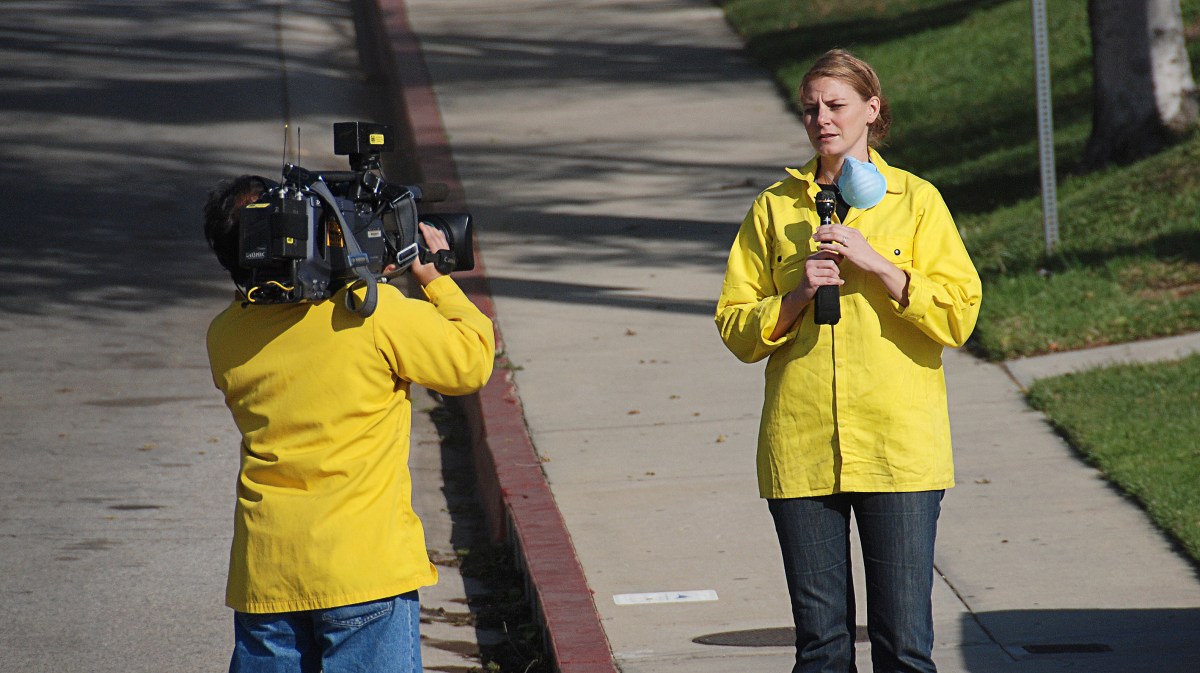
The media plays a great role in every democratic society. They act as the balance which the society needs to function effectively. They put the other arms of government in check. Media serve as the gatekeeper to the door of truth in every government. Works of investigative journalists have revealed corruption and the unscrupulous acts of many public officers. Media informs, educates and entertains. It is expected that media remains objective and truthful in its reports. Mass media is communication intended to reach many people. Mass media reaches everyone one way or the other. More dominant in the past were the broadcast and print media. Digital media allows for a more interactive means of communication. Through the internet, people can access information at their fingertips. It has given exposure to other media forms. More people are using the internet to keep themselves informed of the happenings in their environment. With such a huge reliance on mass media, it is imperative that information and reports are truthful and factual. This essay seeks to discuss the difficulties and challenges involved in reporting reality, using the movies Kill the Messenger and Shock and Awe to illustrate this.
Media performs an agenda-setting role by shaping public opinion. McCombs (2014) describes agenda-setting as “a role of the news media in identifying the key issues and topics of the day and their ability to influence the salience of these issues and topics on the public agenda”. According to Kennamer (1994), “agenda-setting is the outcome of gate-keeping processes – those sets of decisions about what is news and how it is to be presented”. People look to the media for meaning. They form opinions and perceptions based on what they see and hear. Such is the power of the media. McCombs (2014) further states that the “repetition of a topic day after day” will determine how popular and strong the topic will be among the public. “Transfer of issues” between the media and the public in terms of news coverage determines the concern of the public (McCombs, 2014). This consequently affects how people perceive the topic and issues being communicated. It can be said that media tells people what to think and talk about. McCombs describes this as the first stage in creating public opinion. In selecting stories to report, media eventually shapes public opinion. Using the news values, some stories are more prominent than others, and the more prominent ones end up as news of the day.
Giving the role and responsibility of the media, a high level of professionalism is expected to be displayed in carrying out its duties. However, Journalists face different challenges in their line of work. A major difficulty is threat to life and intimidation of journalists who seek to report the truth. This situation is well conveyed in the film, Kill the Messenger which is based on a true-life story. In the film, Gary Webb (Jeremy Renner) a Journalist in the US, discovers in his findings of a drug-related story that Danilo Blandon (Yul Vazquez), a protected witness, was selling drugs for the US Government to support the “rebels” in Nicaragua. Danilo Blandon (Yul Vazquez) made 1.5 billion dollars for the US Government while selling cocaine (25:42 mins). In order to corroborate these statements, Gary Webb (Jeremy Renner) needed to gather more evidence from sources. In doing so, he travelled down to Nicaragua to speak with some sources. He was able to gather some evidence to write his first report. He was being watched by federal agents who had gotten wind of the issues he was inquiring on and did not want the story to reach the public ears. Gary Webb (Jeremy Renner) was threatened by Agent Miller (Gil Bellows) and Agent Jones (Clay Kraski), telling him that he was getting into some sensitive areas (45:23 mins). “There are ongoing operations you’re in danger of exposing…” Agent Jones (Clay Kraski) to Gary Webb (Jeremy Renner) at 45:35mins. They tried to intimidate him with reference to his children. Refusing to be intimidated, Webb went on to publish the report which he titled “Dark Alliance”.
Webb’s family house was being watched by an unknown man with an unknown agenda (1:05:40). Two unknown men also went into his house, looking through his research materials (1:07:07). All over the world, Journalists and their families face intimidation from government and people who do not want the truth about them to be revealed. This makes it difficult for them to report the truth when their lives and that of their loved ones is at stake. Journalists are sometimes jailed, tortured or killed for their investigative reports. One journalist that comes to mind is Jamal Khashoggi, a critic of the Saudi Arabia government. He was assassinated at the Saudi Consulate in Istanbul by agents of the Saudi Government. Corrupt governments find ways of eliminating or dealing with people that get in their way or expose them. In the film, Shock and Awe, Warren Strobel (James Marsden) and Jonathan Landay (Woody Harrelson) both received threatening emails to discourage them from going further in their findings (58:50 mins). In the pursuit of truth, Journalists must “resist threats or any other inducements to influence, distort or suppress information” (NUJ Code of Conduct).
People’s expectation of what the truth should be affect how they receive news report, thereby making it more challenging to report the truth further. In Kill the Messenger, Gary Webb (Jeremy Renner) needed to find a source from the CIA to confirm his report. While he was still in the process, the Washington Post, New York Times and the LA Times faulted his story. San Jose Mercury Newspaper which Webb was writing for could not believe his findings were genuine, concluding that mistakes were made in the writing of the story. His previous sources had twisted their words and claimed that they had no contact with him. Fred Weil (Michael Sheen) said to Webb “my friend, some stories are just too true to tell” (40:53 mins). This statement conflicts with the NUJ Code of Conduct which observes that the public has a right to know and to be informed.
Despite all this, Webb continued in his pursuit of truth. People around him thought he had fabricated the story, giving how messy the issue was, alongside not having an open-source from the CIA. He was even sent to Cupertino bureau to cover local news. While giving a speech at the award ceremony, Webb said “I thought my job was to tell the public the truth, the facts, pretty or not, and let the publishing of those facts make a difference in how people look at things, at themselves, what they stand for…” (1:39:37). Webb admits that good investigative reporting ruffles feathers (1:38:46). Some people found it hard to believe that the US Government was aware of the drug smuggling operations. Investigative journalism aims at discovering the truth and sharing it, even if it is hard to believe.
Influence on the media results into difficulties in reporting reality. In the movie, Shock and Awe, the mainstream media were influenced by the government; The New York Times, The Philadelphia Inquirer, The Washington Post, Los Angeles Times and USA Today. The government used the media to push their drive to war, claiming that Iraq possessed weapons of mass destructions. The mainstream media was used as pawns in the game of attacking Iraq. Influence on the media is prevalent in society today. Ruling ideas dominate the media. For this reason, it was difficult for the public to read or believe what Knight Ridder reported. For example, Mr Strobel (John Newberg) and Mr Maye (Lindsay Ayliffe) adopted the reports of the mainstream media.
In relation to the agenda-setting theory, (Kennamer, 1994) highlights how the media plays a significant role in “establishing or changing policymakers’ agenda. This explains the relationship between mass media and public sources. He agrees that people in positions of authority and power, knowing the power of the media use it to fulfil their own agenda, as was the situation in Shock and Awe. Such influence gives room for the media to serve as a means of spreading propaganda. The film opens with a quote by Bill Meyers, “there is no more important struggle for American Democracy than ensuring a diverse, independent and free media” (00:50 secs).
Knight Ridder Journalists, Jonathan Landay (Woody Harrelson) and Warren Strobel (James Marsden) interviewed different sources to find out if the claim was true. They spoke to a Middle East Expert (16:29 mins), a National Security Expert (17:28 mins), an Administrative Officer (19:35 mins), a former US Government Official (20:23 mins). Rob Reiner (John Walcott) also spoke to an Intelligence Analyst to know if the claim was true (21:54 mins). They learnt from a US Intelligence Officer that the government was involved in “cherry-picking” in justifying the war (42:13 mins). In all their findings, there was no substantial evidence to prove that Iraq possessed the weapons. It is important that journalists have their facts correct before reporting stories. The media should be careful in dealing with sources and not just rely on press releases from the government or from other organisations in writing their reports. Proper verification of information should be carried out. “When the government says something, you only have one question to ask, is it true?” Rob Reiner (John Walcott) says this while addressing his journalists (49:48 mins). According to the film, Kill the Messenger, CIA later published a report acknowledging their involvement with the rebels in Nicaragua, but it was ignored by the media. The real Gary Webb lost his life in 2004. On the other hand, real-life Warren Strobel and Jonathan Landay received an award in 2014 for their courage.
In conclusion, these films shed light on difficulties of reporting reality. Through the re-enactment of the event by the actors, people can learn from the mistakes of the past. Journalists are constantly faced with difficulties of reporting reality, but they must “strive to ensure that information disseminated is honestly conveyed, accurate and fair” (NUJ Code of Conduct). Over 36,000 American servicemen and women were killed or wounded in the war against Iraq. Consequences of not reporting reality could have grave consequences on the public.
 Elohor's Blog