
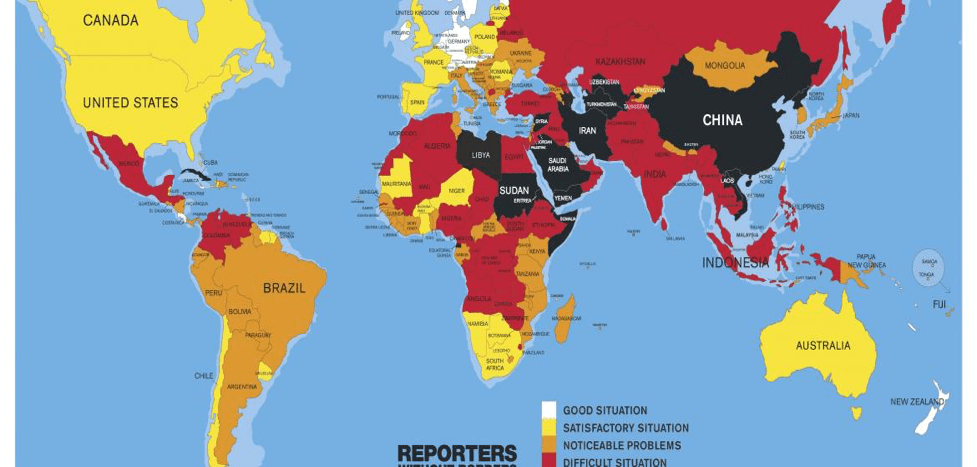
Press or Media laws are guidelines which are imposed by law. Media, radio and television are the main objectives of press regulations. (En.wikipedia.org, 2019). Freedom of the press or freedom of the media is the concept that communication and speech should be recognized as a right to be exercised freely through different media, including printed and electronic media, particularly published materials. These independence means that an oppressive state does not interfere; its preservation can be obtained through constitutional or other legal protection. (En.wikipedia.org, 2019).
Ireland is currently ranked 15, United Kingdom 33 and the United states is 48 from a total of 180 of the World Press Freedom index of 2019. The Index is based on a media freedom analysis that tests pluralism, press autonomy, the performance of the legal framework and journalists ‘ security in 180 countries. (RSF, 2016).
Press Regulatory Bodies
UNITED KINGDOM {U.K}
The Press Complaints Commission (PCC) was a voluntary regulatory body made up of members of the major publishers of British printed newspapers and magazines. The PCC dissolved on Monday, September 8, 2014 and was replaced by Sir Alan Moses ‘ Independent Press Standards Organization (IPSO). (En.m.wikipedia.org, 2019).
The United Kingdom has 16 Code of Practice which includes: Accuracy, Opportunity to reply, Privacy, Harassment, Intrusion into grief, Children, Children in sex cases, Hospitals, Reporting in Crime, Clandestine devices and Subterfuge, Victims of sexual assaults, Discrimination, Confidential sources, Witness payments in criminal trials, Payment to Criminals. (En.m.wikipedia.org, 2019)
Ofcom is the UK media sector regulator and competition authority. This controls the industries of television and radio, fixed line telecoms, mobile phones, postal services, plus the airwaves that control wireless devices. (GOV.UK, 2019)
The mainstream media in the UK is concentrated, the press is regulated by five men: Rupert Murdoch[owner of the News International], Viscount Rothermere (owner of of the Mail], Richard Desmond[owner of the express], and the Twins of the Barclay[owner of telegraph].
United States of America {U.S.A}:
The United States ‘ freedom of the press is constitutionally protected by the First Amendment to the Constitution of the United States. Nonetheless, press freedom is subject to certain limitations in the United States, such as defamation law, lack of protection for whistle-blowers, obstacles to access to information and limits created by public hostility. (En.wikipedia.org, 2019)
The First Amendment, which guarantees press freedom, was introduced as part of the Bill of Rights on 15 December 1791. (HISTORY, 2017)
The Federal Communications Commission controls radio, television, wire, satellite and cable domestic and global communications in all 50 states, the District of Columbia, and the territories of the United States. The Federal communications commission issues licenses and in charge of regulations. The U.S. court system governs the rights enjoyed by newspapers, while television and radio stations are regulated by both the courts and a regulatory commission of government (Courses.lumenlearning.com, 2019)
The FCC also serves as an airwaves police agency, and it can prosecute broadcasters for breaching the air principles for public decency. The FCC can even cancel a broadcaster license in extreme cases, holding it completely off the air.
The FCC has 6 principles which are: The Establishment Clause, Free Exercise Clause, Fress Speech, Free Press, Peaceful Assembly, Redress of Grievances.
The FCC licenses only individual stations; it does not regulate radio or television networks, which are entities made up of multiple stations. Examples of networks are ABC, NBC, CBS, and Fox. The FCC licenses owners of different stations within those networks. (US Legal, 2019)
The USA press is highly concentrated. Bertelsmann is the most troubling case of concentration of ownership in the USA. Bertelsmann owns more than 30 radio stations, 280 media networks and 15 record companies.
IRELAND:
The Press Council of Ireland and Office of the Press Ombudsman was created in 2008. The principles to which their members adhere can be found in the Press Council’s Code of Practice. Promoting freedom of the press and the right to free speech. (http://www.webtrade.ie, 2019)
The Ireland Press Ombudsman’s Office and Press Council provides access to a swift, fair and free independent press grievance process. The grievance process was designed to ensure that there is no violation of the freedom of the press and that the public interest is always protected. These are the fundamental principles of free control of the media worldwide. These are the fundamental principles of free control of the media all over the world.
Both the Press Ombudsman’s Office and Ireland’s Press Council are independent of the government and free of the press in practice. Independent press regulation works better because it depends on member publishing editors and journalists ‘ mutual willingness to conform to the ethical standards of the Code of Practice. (http://www.webtrade.ie, 2019)
Press freedom has obligations. Media members have a duty to maintain the highest standards of integrity and ethics. Ireland has 11 principles which includes: Truth and accuracy, distinguishing facts and comments, fair procedures and honesty, respects for rights, privacy, protection of success, court reporting, prejudice, children, reporting of suicide and publication of the decision of the Press Ombudsman/ Press country. (http://www.webtrade.ie, 2019)
The press in Ireland is highly concentrated. Independent News and Media (INM) dominates 40 percent of the newspaper market every day and on Sunday. Around 1973 and 2012, Tony O’Reilly and his family controlled the INM group of companies. So Denis O’Brien became Independent News & Media’s largest shareholder until April 2019. Broadcasting is now been dominated by RTE.
In Ireland’s constitution of 1937, freedom of the press is guaranteed and generally respected in practice. Ireland’s press is free to form and function and typically do not face excessive pressure. Blasphemy, however, remains a criminal offense, and high ownership concentration affects the sector’s diversity and profitability. (Freedomhouse.org, 2016)
 Elohor's Blog